


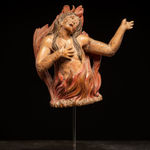
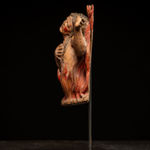
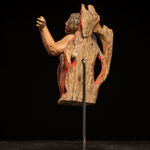
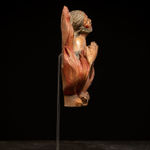
Pair of carved oak Souls in Purgatory, male and female, 17th C, Southern Europe
8 1/4 x 6 1/4 x 3 1/8 in
Plus d'images
-
(View a larger image of thumbnail 1
)

-
(View a larger image of thumbnail 2
)
-
(View a larger image of thumbnail 3
)

-
(View a larger image of thumbnail 4
)

-
(View a larger image of thumbnail 5
)

-
(View a larger image of thumbnail 6
)
-
(View a larger image of thumbnail 7
)

-
(View a larger image of thumbnail 8
)
-
(View a larger image of thumbnail 9
)

-
(View a larger image of thumbnail 10
)

-
(View a larger image of thumbnail 11
)

-
(View a larger image of thumbnail 12
)

-
(View a larger image of thumbnail 13
)

-
(View a larger image of thumbnail 14
)

-
(View a larger image of thumbnail 15
)

-
(View a larger image of thumbnail 16
)
Pair of Oak carved Souls in Purgatory, male and female, 17th C, Southern Europe
These finely carved polychrome wooden figures represent a rare matched pair of male and female souls in Purgatory, intended to evoke empathy and devotional engagement. They depict a female and a male soul engulfed in the flames of Purgatory. Each half-length figure emerges from stylized tongues of fire painted in vivid red and ochre tones. The female soul raises one arm outward while the other hand touches her chest, her face turned upward in a mixture of supplication and hope. The male soul is shown with clasped hands in prayer, his features conveying penitence and spiritual yearning. Both figures retain traces of their original polychromy, contributing to the emotional intensity characteristic of devotional art.
Seventeenth century representations of suffering souls in Purgatory were especially made in Catholic regions influenced by the teachings of the Council of Trent (1545–1563). As part of the Catholic Counter-Reformation, the Council affirmed that sacred images were essential tools for teaching, inspiring devotion, and reinforcing doctrine. Such images were used in chapels, confraternity altars, and private devotional settings to encourage prayers for the deceased and to illustrate the doctrine of spiritual purification. The dynamic carving, heightened gestures, and expressive facial features align with Baroque sensibilities that sought to move the viewer toward compassion and piety.
Both sculptures show expected signs of age, including surface wear, minor losses, and craquelure to the polychrome layers. Overall, they remain structurally sound and preserve strong sculptural presence and color.
Paire d’âmes en chêne sculpté au Purgatoire, masculine et féminine, XVIIᵉ siècle, Europe du Sud
Ces figures en bois polychrome finement sculptées représentent une rare paire assortie d’une âme masculine et d’une âme féminine au Purgatoire, destinée à susciter l’empathie et l’engagement dévotionnel. Elles montrent une âme d’homme et une âme de femme enveloppées par les flammes du Purgatoire. Chaque figure en buste émerge de langues de feu stylisées, peintes dans des tons vifs de rouge et d’ocre. L’âme féminine lève un bras tandis que l’autre main touche sa poitrine, son visage tourné vers le ciel dans un mélange de supplication et d’espérance. L’âme masculine est représentée les mains jointes en prière, ses traits exprimant la pénitence et l’aspiration spirituelle. Toutes deux conservent des traces de leur polychromie d’origine, renforçant l’intensité émotionnelle caractéristique de l’art dévotionnel.
Au XVIIᵉ siècle, les représentations d’âmes souffrantes au Purgatoire furent particulièrement répandues dans les régions catholiques influencées par les enseignements du Concile de Trente (1545–1563). Dans le cadre de la Contre-Réforme catholique, le Concile réaffirma le rôle essentiel des images sacrées comme supports d’enseignement, d’inspiration spirituelle et de renforcement doctrinal. De telles œuvres étaient utilisées dans les chapelles, sur les autels de confréries ou encore dans des contextes dévotionnels privés afin d’encourager les prières pour les défunts et d’illustrer la doctrine de la purification spirituelle. Le dynamisme de la sculpture, l’amplification des gestes et l’expressivité des visages s’accordent pleinement avec les sensibilités baroques qui cherchaient à émouvoir le spectateur et à l’inciter à la piété.
Les deux sculptures présentent des traces d’usure liées au temps, notamment des frottements de surface, de petites pertes de matière et un craquellement de la polychromie. Dans l’ensemble, elles demeurent structurellement saines et conservent une forte présence sculpturale ainsi que la vivacité de leurs couleurs.
Paar eikenhouten gesculpteerde zielen in het Vagevuur, man en vrouw, 17e eeuw, Zuid-Europa
Deze fijn gesculpte polychrome houten figuren vormen een zeldzaam bij elkaar passend paar van een mannelijke en een vrouwelijke ziel in het Vagevuur, bedoeld om empathie en devotionele betrokkenheid op te roepen. Ze tonen een vrouwelijke en een mannelijke ziel die door de vlammen van het Vagevuur worden omhuld. Elke buste verschijnt uit gestileerde vuurtongen, beschilderd in levendige rood- en okertinten. De vrouwelijke ziel heft één arm terwijl de andere hand haar borst raakt, haar gezicht omhoog gericht in een mengeling van smeking en hoop. De mannelijke ziel wordt weergegeven met gevouwen handen in gebed, zijn gelaat vertolkt boetvaardigheid en geestelijk verlangen. Beide figuren bewaren sporen van hun oorspronkelijke polychromie, wat bijdraagt aan de emotionele intensiteit die kenmerkend is voor devotionele kunst.
In de 17e eeuw werden voorstellingen van lijdende zielen in het Vagevuur vooral vervaardigd in katholieke regio’s die beïnvloed waren door de leer van het Concilie van Trente (1545–1563). In het kader van de katholieke Contrareformatie bevestigde het Concilie dat heilige afbeeldingen essentiële hulpmiddelen waren voor onderricht, voor het inspireren van devotie en voor het versterken van de katholieke doctrine. Dergelijke voorstellingen werden gebruikt in kapellen, op altaren van broederschappen en in private devotionele contexten om gebeden voor de overledenen aan te moedigen en om de leer van geestelijke zuivering te illustreren. De dynamische snijwijze, de uitgesproken gebaren en de expressieve gelaatsuitdrukkingen sluiten nauw aan bij de barokke esthetiek die erop gericht was de toeschouwer te ontroeren en tot vroomheid aan te zetten.
Beide sculpturen vertonen verwachte ouderdomssporen, waaronder oppervlakkige slijtage, kleine materiaalverliezen en craquelé in de polychromie. Over het geheel genomen verkeren zij in een stabiele, goede staat en behouden zij een sterke sculpturale aanwezigheid en kleurwerking.
Paar eichenholzgeschnitzter Seelen im Fegefeuer, männlich und weiblich, 17. Jahrhundert, Südeuropa
Diese fein geschnitzten, polychrom gefassten Holzfiguren stellen ein seltenes, zusammengehöriges Paar einer männlichen und einer weiblichen Seele im Fegefeuer dar, geschaffen, um Empathie und religiöse Anteilnahme zu wecken. Sie zeigen eine weibliche und eine männliche Seele, die von den Flammen des Fegefeuers umgeben sind. Jede Halbfigur erhebt sich aus stilisierten Flammenzungen, die in lebhaften Rot- und Ockertönen bemalt sind. Die weibliche Seele hebt einen Arm, während die andere Hand ihre Brust berührt; ihr nach oben gerichtetes Gesicht verbindet Flehen und Hoffnung. Die männliche Seele ist mit gefalteten Händen im Gebet dargestellt, ihre Gesichtszüge drücken Bußfertigkeit und geistiges Sehnen aus. Beide Figuren bewahren Spuren ihrer ursprünglichen Polychromie, was zur emotionalen Intensität beiträgt, die für die Andachtskunst charakteristisch ist.
Darstellungen leidender Seelen im Fegefeuer wurden im 17. Jahrhundert besonders in katholischen Regionen geschaffen, die von den Lehren des Konzils von Trient (1545–1563) geprägt waren. Im Rahmen der katholischen Gegenreformation bestätigte das Konzil die wesentliche Bedeutung heiliger Bilder als Mittel der Belehrung, der religiösen Inspiration und der Festigung der kirchlichen Lehre. Solche Werke wurden in Kapellen, auf Bruderschaftsaltären und in privaten Andachtssituationen verwendet, um Gebete für die Verstorbenen anzuregen und die Lehre der geistigen Läuterung zu veranschaulichen. Die dynamische Schnitzweise, die gesteigerten Gesten und die ausdrucksstarken Gesichtszüge entsprechen der barocken Ästhetik, die darauf abzielte, den Betrachter zu bewegen und zur Frömmigkeit anzuregen.
Beide Skulpturen zeigen altersgemäße Gebrauchsspuren, darunter Oberflächenabrieb, kleine Materialverluste und Craquelé der Polychromie. Insgesamt befinden sie sich in stabilem Zustand und bewahren eine starke plastische Präsenz sowie die Wirkung ihrer Farbfassung.
Join our mailing list
* denotes required fields
We will process the personal data you have supplied in accordance with our privacy policy (available on request). You can unsubscribe or change your preferences at any time by clicking the link in our emails.